Skip to content

The Escapists · Ten Lives · 1842 to Now

The ten greatest escapists in modern history

Tropical escapism did not appear out of nowhere. It was built, over about a hundred and eighty years, by a small number of people who decided the life in front of them was not the only one available — and then made the alternative so vivid that the rest of us could visit.

Some of them physically left. Some of them built the island indoors and never had to. One of them spent forty years recovering what the others had lost. Listed in the order they made their escape.

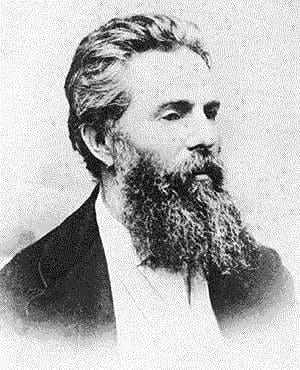
Portrait photograph of the American author Herman Melville.

No. 1 · 1819–1891

Herman Melville

The one who actually jumped ship

Escaped from —
The forecastle of the whaler Acushnet
Escaped to —
Nuku Hiva, Marquesas Islands, 1842

Before it was a bar, a record, or a shirt, it was a young sailor deciding he had had enough. In the summer of 1842 Melville deserted his whaling ship in the Marquesas and spent roughly a month living in a valley among the Taipi people, an experience he stretched into four months and a book.

That book was Typee, and it made him briefly famous — far more so in his lifetime than Moby-Dick, which sold poorly and was largely forgotten until decades after he died. Typee is where the Western fantasy of the South Seas gets its shape: the harbor, the valley, the sense that a better life is running parallel to yours somewhere warm.

Everyone on this list is, in some sense, working from his outline.

What they left us

The template. Every tropical escape since is a variation on his.
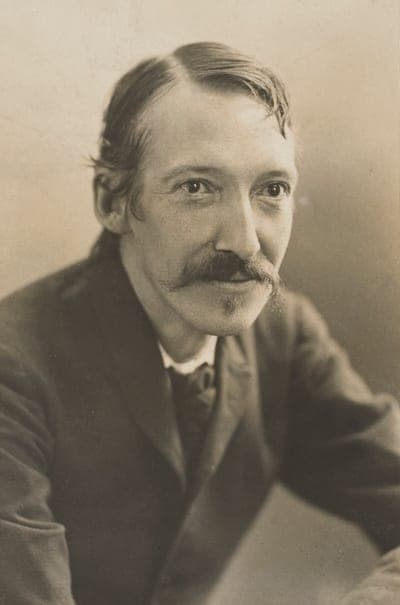

Portrait photograph of the Scottish writer Robert Louis Stevenson.

No. 2 · 1850–1894

Robert Louis Stevenson

Tusitala, the teller of tales

Escaped from —
A sickbed in Scotland
Escaped to —
Vailima, Samoa, 1890

Stevenson spent his life ill — lungs that kept him indoors through Edinburgh winters — and in 1888 he chartered a yacht and went looking for air he could breathe. He found the Pacific, and after two years of sailing he bought land above Apia, in Samoa, and stayed.

He did not stay as a tourist. He learned the politics, took the side of Samoans against the colonial administration carving up their islands, and wrote furious letters to London about it. Samoans called him Tusitala, teller of tales. When he died at 44, they cut a path up Mount Vaea and carried him to the top.

Of everyone here, he is the one who went and did not come back, and the one who treated the island as a place rather than a backdrop.

What they left us

Proof the escape can be permanent — and that it comes with obligations.


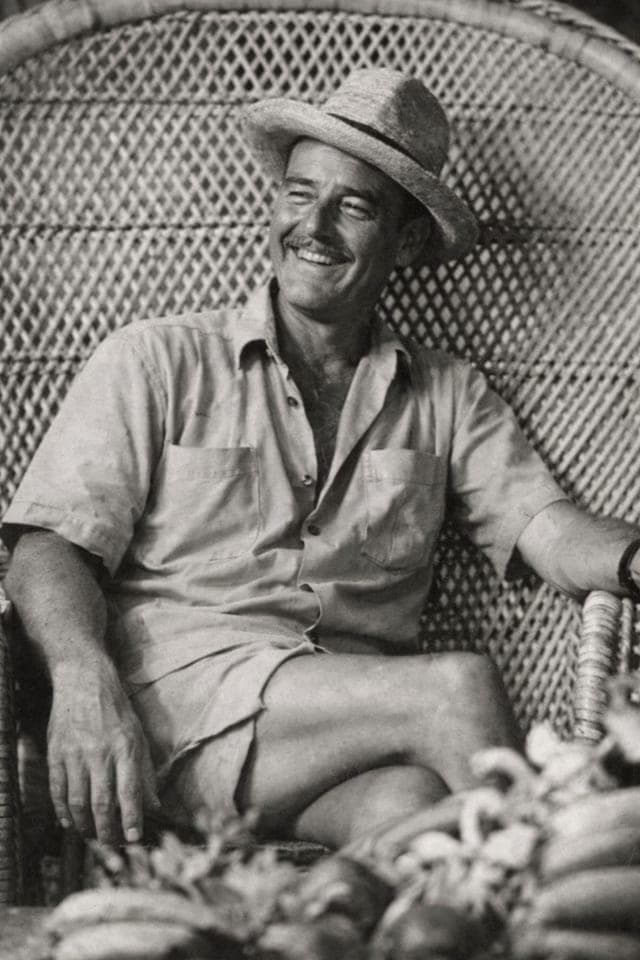
Photograph of Donn Beach, born Ernest Raymond Beaumont Gantt, seated in a wicker chair in a straw hat.

No. 3 · 1907–1989

Donn Beach

The man who built the island indoors

Escaped from —
Prohibition-era America, by way of a bootlegging boat
Escaped to —
A rented storefront in Hollywood, 1933

Ernest Raymond Beaumont Gantt had already knocked around the Caribbean and the Pacific — and, by his own telling, run liquor during Prohibition — when he opened a tiny bar on McCadden Place in Hollywood in 1933, the year Prohibition ended. He filled it with what he had dragged home: nets, floats, carved masks, parts of boats. Then he legally renamed himself after the bar.

He invented the tiki bar as a form, and most of what happens inside one. The Zombie is his. The rum-forward, citrus-and-spice architecture that every tiki drink still uses is his. So is the paranoid genius of the coded, numbered syrup bottles that kept his own bartenders from learning the recipes.

He is the hinge of this entire list: the point where escapism stopped being a voyage you took and became a room you could walk into on a Tuesday.

What they left us

The tiki bar itself, and the Zombie. Limit two.


No. 4 · Active 1930s–1950s

Cora “Sunny” Sund

The one who turned a bar into an empire

Escaped from —
The footnote she was filed under for fifty years
Escaped to —
Control of the entire mainland operation

Donn Beach invented the tiki bar. Sunny Sund is the reason there was more than one of them.

She married him in the late 1930s and ran the business while he was in the Army during the Second World War. When the marriage ended, she came out of it holding the mainland restaurants — and proceeded to do the thing he never did, turning a single Hollywood room into a chain across the country while he stayed in Waikiki.

Her paper trail is thin compared to the men on this list, and some details of her life are recorded inconsistently or not at all, which is itself the point. Tiki history is full of people who built the thing and were credited with none of it.

What they left us

Scale. Without her, tiki is one bar in Hollywood and a good story.


No. 5 · 1902–1984

Victor “Trader Vic” Bergeron

The rival who wrote the best drink

Escaped from —
A bar in Oakland called Hinky Dink's
Escaped to —
A global chain, and the Mai Tai, 1944

Bergeron lost a leg to tuberculosis as a child and spent the rest of his life turning it into part of the act — he would tell tourists a shark got it, then rap on the wooden one. He opened Hinky Dink's in Oakland in 1934, went to see what Donn Beach was doing in Hollywood, came home, and rebuilt his bar entirely.

What he added was rigor. Where Donn was a mystic with a secret bottle system, Vic was an operator who wrote things down, trained staff, standardized a kitchen, and exported the room to Chicago, London, Tokyo, and Munich. He also, in 1944, built the Mai Tai — a dry, almond-scented rum sour that is still the best argument the genre has.

He and Donn feuded over who invented what for the rest of their lives. Vic's version is the one the world drinks.

What they left us

The Mai Tai, and the proof that a fantasy could be run like a business.


No. 6 · 1922–1996

Les Baxter

The composer who scored a jungle that never existed

Escaped from —
A classical conservatory training
Escaped to —
Le Sacre du Sauvage — Ritual of the Savage, 1951

Baxter was a serious musician — conservatory-trained, a working arranger for Nat King Cole and others — who in 1951 released an album of orchestral pieces about a rainforest he had never visited, and accidentally invented a genre.

Ritual of the Savage is exotica before the word existed: lush strings, unplaceable percussion, melodies that sound like a place you are certain you have been and definitely have not. It is a soundtrack to a film nobody shot.

Almost every tiki bar playlist since is downstream of this record, and the honest thing to say about it is that its jungle is entirely imaginary — which is either the flaw or the entire point, depending on the evening.

What they left us

Exotica, the sound. The genre's founding document.


No. 7 · 1911–2005

Martin Denny

The bandleader who hired the frogs

Escaped from —
A jobbing pianist's career on the mainland
Escaped to —
The Shell Bar, Honolulu — and the top of the charts

Denny took what Baxter had written and made it a phenomenon, largely by accident. Playing an outdoor lounge in Honolulu, his band noticed that the resident bullfrogs and birds answered the music. The audience loved it. So the band started doing the birdcalls themselves.

That bit of stagecraft became the sound of the record Exotica in 1957, and by 1959 “Quiet Village” had carried it to the top of the American charts. It gave the genre its name and put it in millions of suburban living rooms with a hi-fi and an ambition.

If you have ever heard a birdcall over a vibraphone and immediately felt several degrees warmer, that is Denny, and he did it on purpose.

What they left us

The birdcall. The genre's name. The record on the bar's turntable.


Portrait photograph of the Norwegian explorer Thor Heyerdahl.

No. 8 · 1914–2002

Thor Heyerdahl

The one who actually sailed it

Escaped from —
The safety of an academic argument
Escaped to —
4,300 miles of open Pacific on balsa logs, 1947

Everyone else on this list escaped toward an island. Heyerdahl escaped onto the ocean itself. In 1947, to argue that ancient South Americans could have reached Polynesia, he built a raft out of balsa logs using no modern materials, pushed off from Peru with five companions, and drifted 101 days to an atoll in the Tuamotus.

The book sold in the tens of millions and the documentary won an Academy Award. The raft was named Kon-Tiki, and that name — more than any bar or record — is why a certain kind of carved, oceanic, thatched aesthetic is called what it is.

The honest footnote: his actual thesis has not aged well. Genetic and archaeological evidence points firmly to Polynesia being settled from the west, by extraordinary Austronesian navigators, not drifted into from the east. He was wrong about the history and completely serious about the voyage, which is a rare and interesting way to be remembered.

What they left us

The name Kon-Tiki, and the standard for actually going.


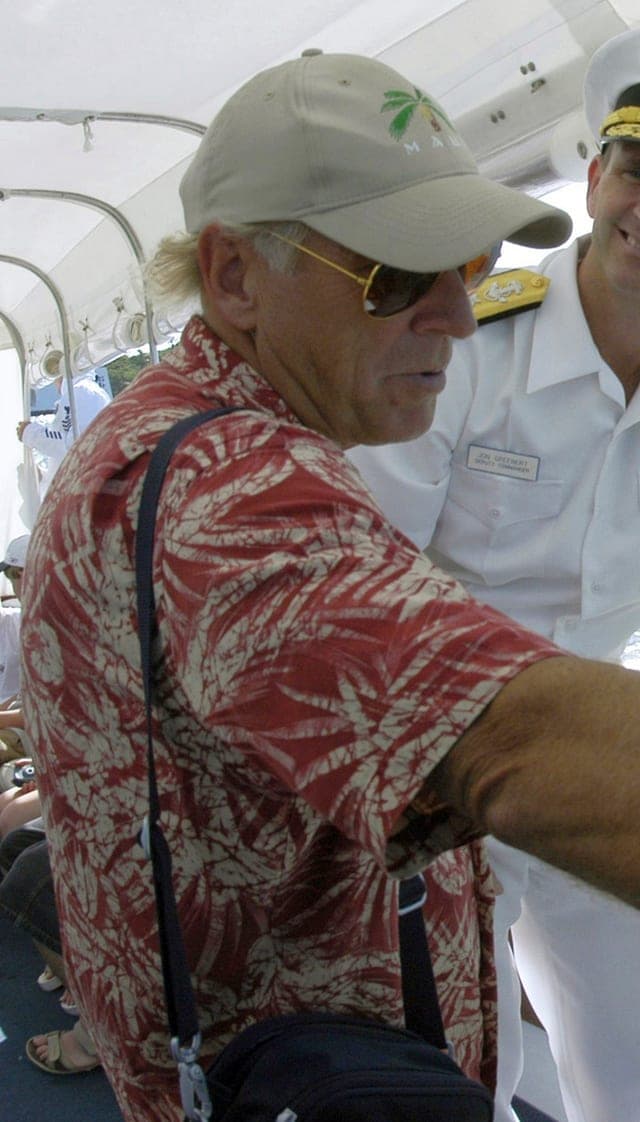
Photograph of the musician Jimmy Buffett in a tropical print shirt and cap aboard a boat.

No. 9 · 1946–2023

Jimmy Buffett

The one who franchised the feeling

Escaped from —
A failed Nashville country career
Escaped to —
Key West, and a state of mind with its own citizenry

Buffett went to Nashville, did not make it, and drove to Key West instead — which turned out to be the most commercially significant wrong turn in American music. “Margaritaville” landed in 1977 and did something no song on this list's soundtrack had managed: it gave the escape a permanent address that anyone could claim.

What followed was stranger and larger than the music. His audience organized itself into Parrot Head Clubs — hundreds of them, most of them genuinely functioning as local charities that raise money and clean beaches. Two of the oldest are here in Northeast Florida.

Purists sometimes want to keep trop rock at arm's length from tiki. We do not. It is the same instinct wearing a louder shirt, and Buffett convinced several million people that the island was available on a Tuesday, which is more or less the entire mission.

What they left us

The Parrot Head nation, and the idea that escape scales.


Photograph of drink historian Jeff “Beachbum” Berry speaking at a lectern in a straw hat.

No. 10 · Working today

Jeff “Beachbum” Berry

The archaeologist who got the recipes back

Escaped from —
A screenwriting career in Los Angeles
Escaped to —
Forty years of hunting down dead men's notebooks

By the 1990s the tiki canon was effectively lost. Donn Beach had guarded his recipes with coded bottles and taken most of them with him; the bars that survived were serving sweet approximations with the right names on them. A Zombie ordered in 1995 had almost no relationship to a Zombie poured in 1934.

Berry spent decades fixing that — tracking down Donn's surviving bartenders, talking his way into family notebooks, and reconstructing specs line by line. The 1934 Zombie came back through a notebook kept by one of Donn's bartenders and was published in Sippin' Safari in 2007. He opened his own bar, Latitude 29, in New Orleans in 2014.

He is on this list because everyone above him made something and he is the reason we still have it. Escapism has a research wing, and he is it.

What they left us

The recovered canon. The reason the drinks on our menu are the real ones.

One thing worth saying

Ten Westerners, nine of them men, and most of them found their paradise somewhere that already belonged to someone else. Polynesian Pop is a fantasy assembled from real cultures, largely by people who were visiting. We think the drinks, the records, and the rooms are worth loving. We also think the islands everyone here was escaping to were somebody’s home, and that a scene is healthier when it can hold both of those at once.

Escape locally, once a month

Rum & Thatch is a free tiki social club in Northeast Florida. We gather at a great tiki bar (a Mixer), on the sand at golden hour (a Driftwood Social), and at a cigar lounge (an Ember Night), across Jacksonville, Ponte Vedra Beach, and St. Augustine. Free to join, no invite, strictly 21+.

Want the drinks these people invented? They’re all in The Canon — ten recipes with the real specs. For the movement they built, see what Polynesian Pop actually is, and the rest of the library is here.

Image credits

Entries shown with initials instead of a photograph have no freely licensed portrait available. We don’t use images we can’t license, and we don’t generate fake ones of real people.

The 10 Greatest Escapists in Modern History · Rum & Thatch